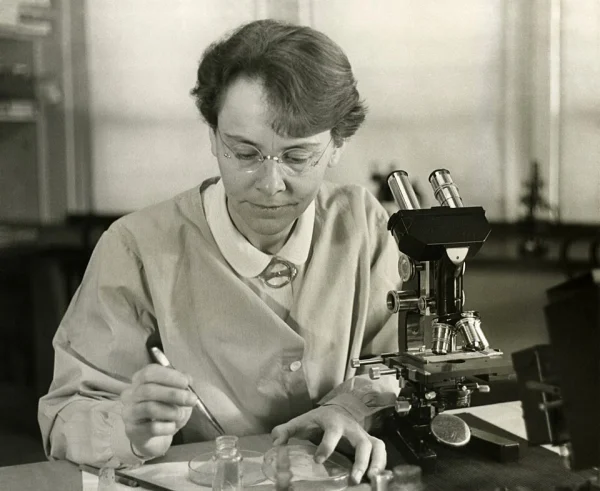
Barbara McClintock (1902–1992) was an American cytogeneticist who received the 1983 Nobel Prize in Physiology or Medicine. Her research focused on maize genetics, including the discovery of genetic transposition.
Barbara McClintockSource portrait · Smithsonian Institution/Science Service; Restored by Adam CuerdenWikimedia Commons · Public domainResized and converted; display may crop to fit.
The person behind the words
Life & biography
Barbara McClintock (June 16, 1902–September 2, 1992) was an American cytogeneticist. She earned a PhD in botany from Cornell University in 1927 and began a career in maize cytogenetics. She developed techniques for visualizing maize chromosomes and used microscopic analysis to study chromosome change, genetic recombination, telomeres, and centromeres.
In the 1940s and 1950s, McClintock discovered transposons and developed theories about the suppression and expression of genetic information across generations of maize plants. She later studied the cytogenetics and ethnobotany of South American maize races. Her work gained broader recognition after other scientists confirmed related mechanisms; she received the 1983 Nobel Prize in Physiology or Medicine for the discovery of genetic transposition.