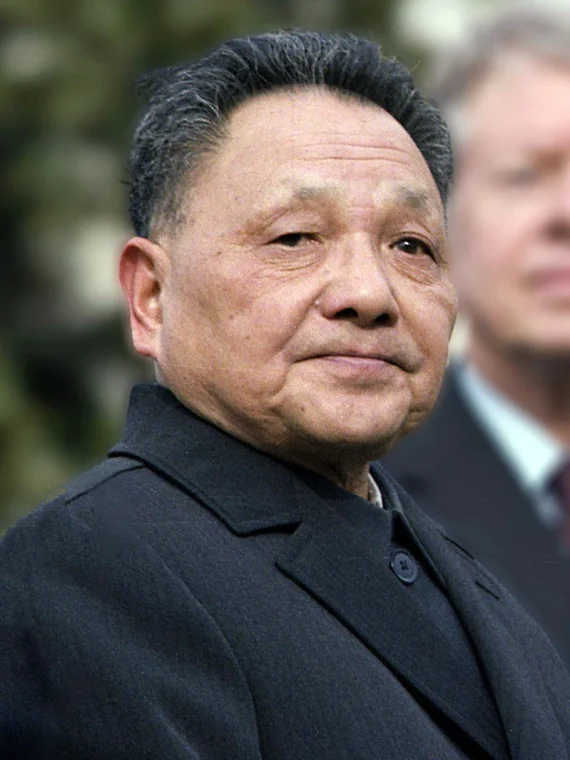
Deng Xiaoping (1904–1997) was a Chinese statesman, revolutionary, and political theorist who served as the People's Republic of China's paramount leader from 1978 to 1989. His reform and opening up policies introduced market incentives and expanded China's integration into the global economy.
Deng XiaopingSource portrait · Unknown authorUnknown authorWikimedia Commons · Public domainResized and converted; display may crop to fit.
The person behind the words
Life & biography
Deng Xiaoping was born in Sichuan on 22 August 1904. During the 1920s, he studied and worked in France as part of the Work–Study Movement, where he encountered Marxism–Leninism, and later studied in Moscow. He joined the Chinese Communist Party in 1924 and held political and military roles during the Chinese Civil War and the Second Sino-Japanese War.
After Mao Zedong's death, Deng became China's paramount leader by 1978. His reform and opening up policies introduced market incentives, special economic zones, and greater foreign investment. He also promoted the principle of “one country, two systems.” His legacy includes both China's economic transformation and the 1989 crackdown on the Tiananmen Square protests.