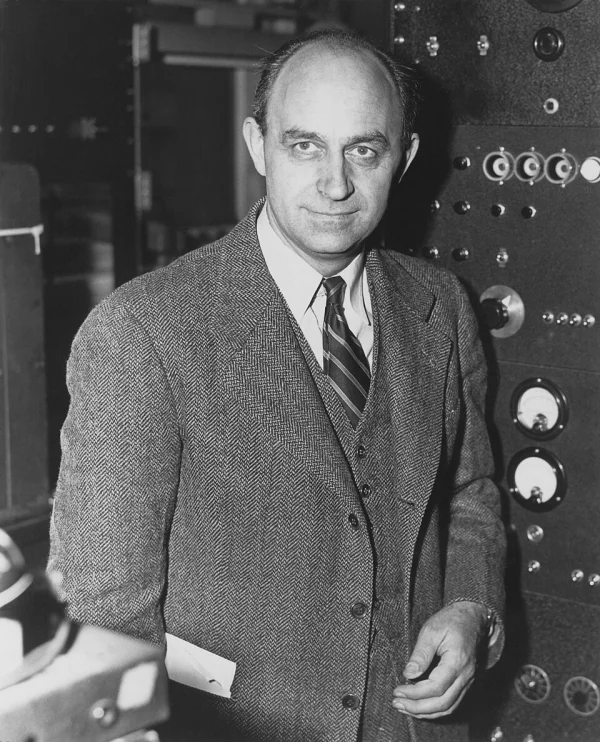
Enrico Fermi was an Italian and naturalized-American physicist whose work advanced statistical mechanics, quantum theory, and nuclear and particle physics. He led the University of Chicago team that built Chicago Pile-1, which achieved the first human-created, self-sustaining nuclear chain reaction in 1942.
Enrico FermiSource portrait · Department of Energy-Office of Public Affairs, restored by YannWikimedia Commons · Public domainResized and converted; display may crop to fit.
The person behind the words
Life & biography
Fermi made major contributions to statistical mechanics, quantum theory, and nuclear and particle physics. His application of the exclusion principle to an ideal gas led to the formulation now known as Fermi–Dirac statistics. He also developed a model of beta decay involving the neutrino and investigated how slow neutrons interact with atomic nuclei. He received the 1938 Nobel Prize in Physics for work on neutron irradiation and slow-neutron nuclear reactions; the new elements he initially thought had been produced were later understood to be nuclear fission products.
After leaving Italy in 1938, Fermi worked in the United States on the Manhattan Project. He led the Chicago team that designed and built Chicago Pile-1, which went critical on 2 December 1942. After the war, he helped establish the Institute for Nuclear Studies in Chicago and served on the General Advisory Committee to the Atomic Energy Commission. He testified on J. Robert Oppenheimer’s behalf at the 1954 security-clearance hearing.