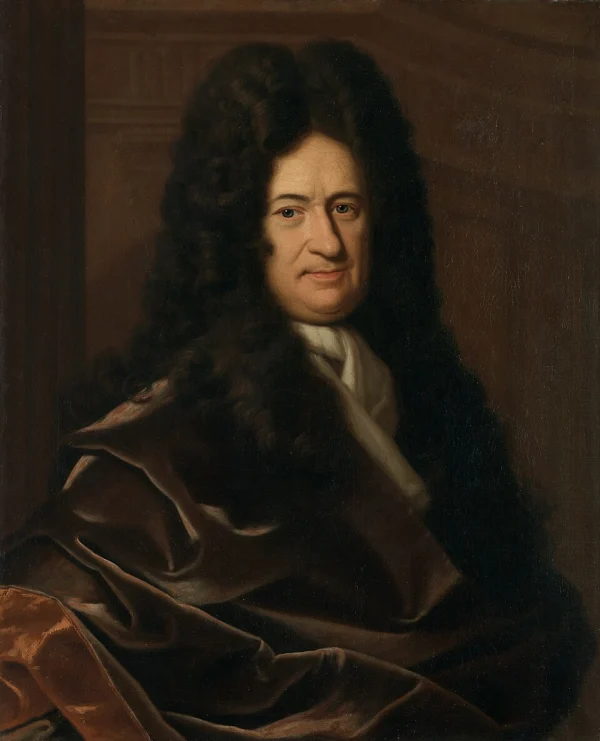
Gottfried Wilhelm Leibniz was a German polymath whose work spanned mathematics, philosophy, science, and diplomacy. He independently developed differential and integral calculus and contributed to binary arithmetic and other fields.
Gottfried Wilhelm LeibnizSource portrait · Christoph Bernhard FranckeWikimedia Commons · Public domainResized and converted; display may crop to fit.
The person behind the words
Life & biography
Gottfried Wilhelm Leibniz (1 July 1646 [Old Style 21 June]–14 November 1716) was a German polymath active as a mathematician, philosopher, scientist, and diplomat. Alongside Isaac Newton, he is widely credited with the invention of calculus; Leibniz’s notation became the conventional expression of the subject. He also contributed to binary arithmetic and statistics.
Leibniz wrote on a broad range of subjects, including philosophy, theology, law, and history. He developed a cataloguing system for the Herzog August Library and described a pinwheel calculator in 1685; the Leibniz wheel was later used in the arithmometer. In philosophy, he was a leading representative of seventeenth-century rationalism and is associated with the view that this is, in a qualified sense, the best possible world.