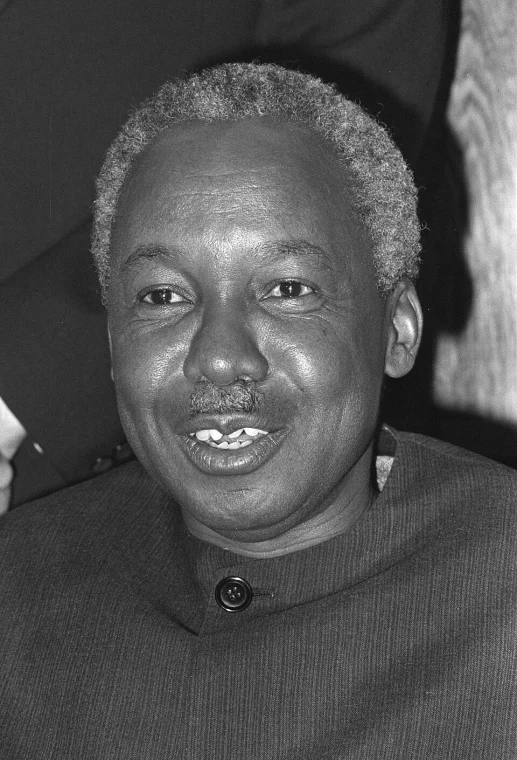
Politician, anti-colonial activist, political theorist
Julius Nyerere (1922–1999) was a Tanzanian anti-colonial activist and politician who led Tanganyika to independence and served as Tanzania’s president from 1964 to 1985. He promoted Ujamaa, a political philosophy associated with African socialism.
Julius NyerereSource portrait · Rob Mieremet / AnefoWikimedia Commons · CC0Resized and converted; display may crop to fit.
The person behind the words
Life & biography
Born in Butiama in what was then the British colony of Tanganyika, Nyerere studied at Makerere College and Edinburgh University. After returning to Tanganyika, he worked as a school teacher and helped form the Tanganyika African National Union (TANU) in 1954, campaigning for independence through non-violent protest. He became prime minister in 1961 and Tanganyika’s first president in 1962.
After Tanganyika and Zanzibar united to form Tanzania in 1964, Nyerere served as president until 1985. His government promoted national self-reliance and Ujamaa; policies included nationalization and expanded education and healthcare, while communal farming reforms hampered food production. He stepped down in 1985, remained party chair until 1990, and later mediated efforts to end Burundi’s civil war. His political legacy is described as controversial, including both respect for national unity and criticism of one-party rule and economic management.