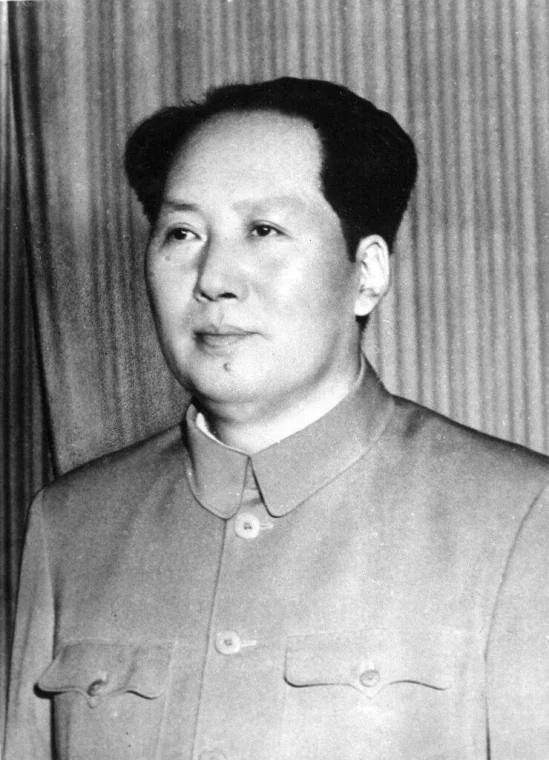
Communist revolutionary; political theorist; political leader
Mao Zedong (1893–1976) was a Chinese communist revolutionary and political theorist, and a founding member of the Chinese Communist Party. He led the People’s Republic of China from its founding in 1949 until his death.
Mao ZedongSource portrait · Chen Zhengqing (1917–1966)Wikimedia Commons · Public domainResized and converted; display may crop to fit.
The person behind the words
Life & biography
Mao Zedong was born in Shaoshan, Hunan, on 26 December 1893. After studying in Changsha, he encountered Marxism while working as a librarian at Peking University and took part in the May Fourth Movement of 1919. He became a founding member of the Chinese Communist Party in 1921 and later helped build the Chinese Red Army. In 1935, during the Long March, he became the party’s leader.
After the Chinese Civil War, Mao led the People’s Republic of China from 1949 until his death on 9 September 1976. His leadership included the Great Leap Forward (1958–1962) and the Cultural Revolution, launched in 1966. The source describes both the severe human costs of his rule and changes in literacy, healthcare, education, and China’s international position; these are complex historical assessments and require editorial review.