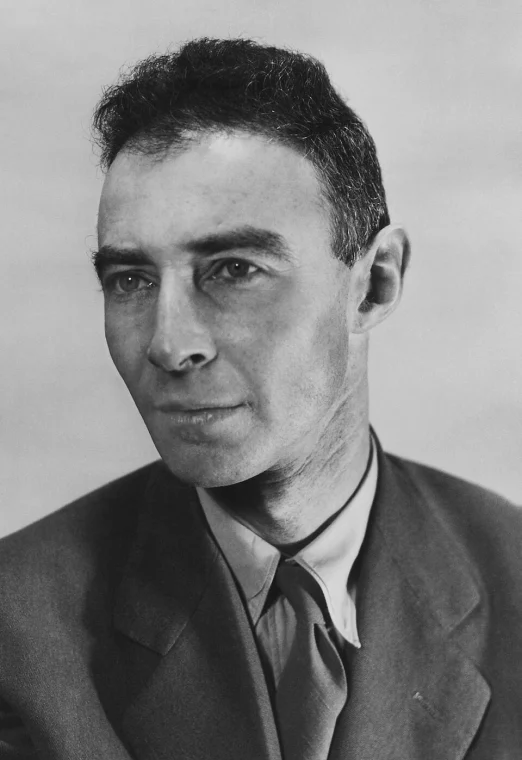
Robert Oppenheimer was an American theoretical physicist who directed the Manhattan Project’s Los Alamos Laboratory during World War II. His work also included contributions to quantum and nuclear physics.
Robert OppenheimerSource portrait · Unknown authorUnknown authorWikimedia Commons · Public domainResized and converted; display may crop to fit.
The person behind the words
Life & biography
Robert Oppenheimer, born Julius Robert Oppenheimer, was born on April 22, 1904. He earned a chemistry degree from Harvard in 1925 and a doctorate in physics from the University of Göttingen in 1927. He later joined the University of California, Berkeley, where he became a full professor in 1936. His research addressed quantum mechanics and nuclear physics, and he contributed to work on molecular wave functions, positrons, and astrophysics.
Recruited to the Manhattan Project in 1942, Oppenheimer became director of its Los Alamos Laboratory in 1943 and was present at the Trinity test in 1945. After the war, he directed the Institute for Advanced Study and chaired the Atomic Energy Commission’s General Advisory Committee. He advocated international control of nuclear weapons and opposed development of the hydrogen bomb. His security clearance was revoked in 1954; he continued working in physics and received the Enrico Fermi Award in 1963. The 1954 decision was vacated in 2022.