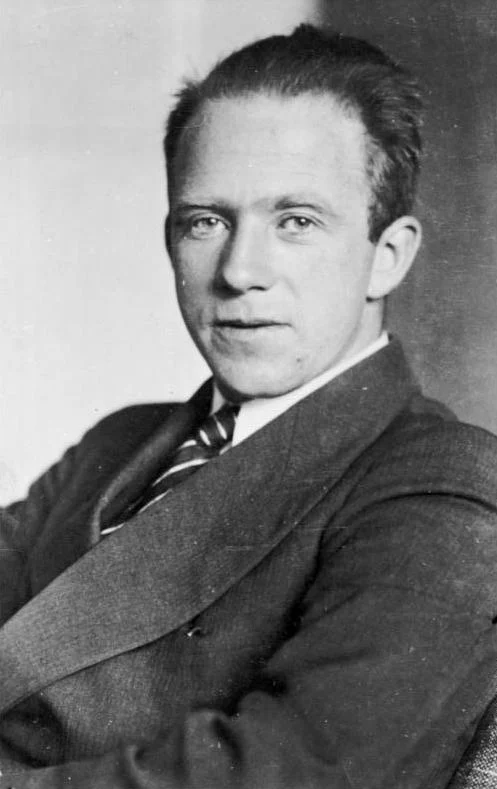
Werner Heisenberg was a German theoretical physicist and a pioneer of quantum mechanics. He received the 1932 Nobel Prize in Physics for the creation of quantum mechanics.
Werner HeisenbergPhotograph · Unknown authorUnknown authorWikimedia Commons · CC BY-SA 3.0 deResized and converted; display may crop to fit.
The person behind the words
Life & biography
Werner Karl Heisenberg (1901–1976) was a German theoretical physicist and one of the principal pioneers of quantum mechanics. He published his 1925 paper that reinterpreted old quantum theory; work with Max Born and Pascual Jordan further developed the matrix formulation. In 1927 he published the uncertainty principle, and in 1932 he received the Nobel Prize in Physics for the creation of quantum mechanics.
Heisenberg also contributed to research on turbulent flows, the atomic nucleus, ferromagnetism, cosmic rays and subatomic particles. After World War II, he directed the Kaiser Wilhelm Institute for Physics, later renamed the Max Planck Institute for Physics, and subsequently led the Max Planck Institute for Physics and Astrophysics from 1960 to 1970. He also held leadership roles in German scientific organizations.