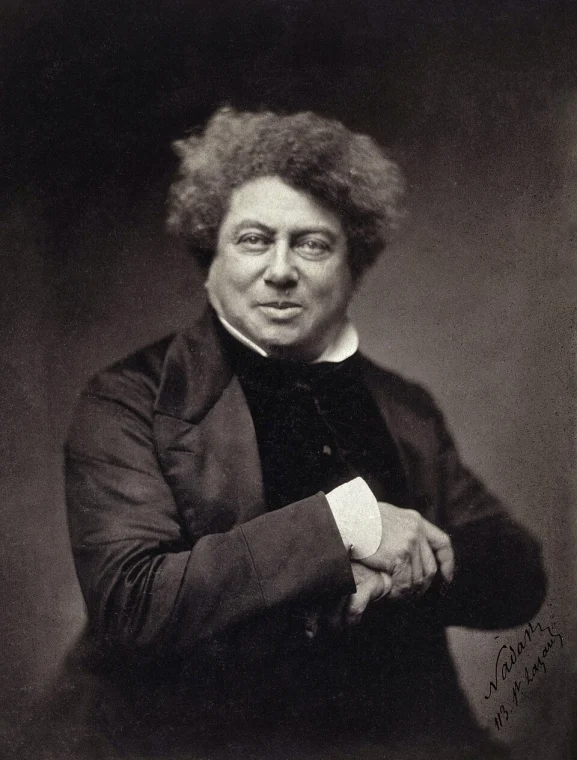
Alexandre DumasSource portrait · NadarWikimedia Commons · Public domainResized and converted; display may crop to fit.
The person behind the words
Life & biography
Alexandre Dumas, born Alexandre Davy de la Pailleterie, was a French novelist and playwright. He began his career writing plays and later wrote historical adventure novels, many first published as serials, including The Count of Monte Cristo, The Three Musketeers, Twenty Years After and The Vicomte of Bragelonne: Ten Years Later.
In the 1840s, Dumas founded the Théâtre Historique in Paris. In 1861, while in Italy, he founded and published L'Indépendant, a newspaper supporting Italian unification. He returned to Paris in 1864.
The narrator describes D’Artagnan’s gratitude toward de Tréville. The catalogue credits Alexandre Dumas and Auguste Maquet as authors. Literary passage, not a personal statement by the author or a verbatim historical record. The retained English edition/catalogue does not name a translator; no translator identity is asserted. Hindi is an editorial translation from this English edition, not directly from the French or Spanish original.
Athos speaks of Buckingham; this is fictional dialogue, not a recorded historical speech. The catalogue credits Alexandre Dumas and Auguste Maquet as authors. Literary passage, not a personal statement by the author or a verbatim historical record. The retained English edition/catalogue does not name a translator; no translator identity is asserted. Hindi is an editorial translation from this English edition, not directly from the French or Spanish original.
The narrator considers the contradictory character of Louis XIII in the novel. The catalogue credits Alexandre Dumas and Auguste Maquet as authors. Literary passage, not a personal statement by the author or a verbatim historical record. The retained English edition/catalogue does not name a translator; no translator identity is asserted. Hindi is an editorial translation from this English edition, not directly from the French or Spanish original.
The narrator describes D’Artagnan choosing a side between king and cardinal. The catalogue credits Alexandre Dumas and Auguste Maquet as authors. Literary passage, not a personal statement by the author or a verbatim historical record. The retained English edition/catalogue does not name a translator; no translator identity is asserted. Hindi is an editorial translation from this English edition, not directly from the French or Spanish original.
Athos speaks to D’Artagnan before their planned duel. The catalogue credits Alexandre Dumas and Auguste Maquet as authors. Literary passage, not a personal statement by the author or a verbatim historical record. The retained English edition/catalogue does not name a translator; no translator identity is asserted. Hindi is an editorial translation from this English edition, not directly from the French or Spanish original.
Aramis contrasts his temporary military role with his ambition for the Church. The catalogue credits Alexandre Dumas and Auguste Maquet as authors. Literary passage, not a personal statement by the author or a verbatim historical record. The retained English edition/catalogue does not name a translator; no translator identity is asserted. Hindi is an editorial translation from this English edition, not directly from the French or Spanish original.
Aramis replies to D’Artagnan while arranging a duel. The catalogue credits Alexandre Dumas and Auguste Maquet as authors. Literary passage, not a personal statement by the author or a verbatim historical record. The retained English edition/catalogue does not name a translator; no translator identity is asserted. Hindi is an editorial translation from this English edition, not directly from the French or Spanish original.
The narrator describes the reputation of Monsieur de Tréville. The catalogue credits Alexandre Dumas and Auguste Maquet as authors. Literary passage, not a personal statement by the author or a verbatim historical record. The retained English edition/catalogue does not name a translator; no translator identity is asserted. Hindi is an editorial translation from this English edition, not directly from the French or Spanish original.
The narrator describes D’Artagnan after the adventure at Meung. The catalogue credits Alexandre Dumas and Auguste Maquet as authors. Literary passage, not a personal statement by the author or a verbatim historical record. The retained English edition/catalogue does not name a translator; no translator identity is asserted. Hindi is an editorial translation from this English edition, not directly from the French or Spanish original.
D’Artagnan’s father addresses his son before he leaves home. The catalogue credits Alexandre Dumas and Auguste Maquet as authors. Literary passage, not a personal statement by the author or a verbatim historical record. The retained English edition/catalogue does not name a translator; no translator identity is asserted. Hindi is an editorial translation from this English edition, not directly from the French or Spanish original.