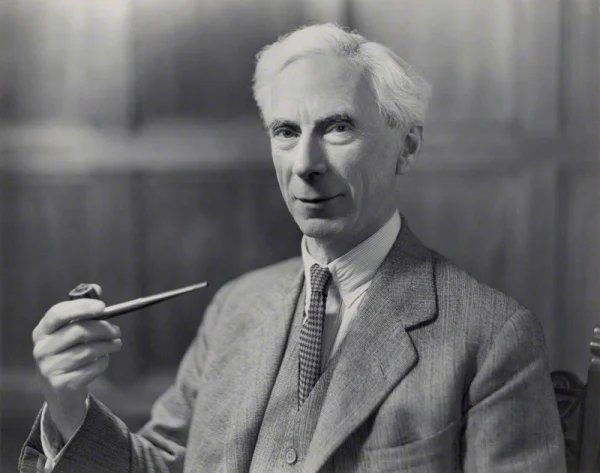
Bertrand Russell (1872–1970) was an English mathematician and philosopher and a founder of analytic philosophy. His work included logic, set theory and philosophy of language.
Bertrand RussellSource portrait · Bassano LtdWikimedia Commons · Public domainResized and converted; display may crop to fit.
The person behind the words
Life & biography
Bertrand Arthur William Russell, 3rd Earl Russell, was born on 18 May 1872 and died on 2 February 1970. He studied mathematics at Trinity College, Cambridge, graduating with a first-class degree in 1893. His friendship with G. E. Moore helped lead him away from British idealism toward analytic philosophy and logical analysis.
With Alfred North Whitehead, Russell wrote Principia Mathematica, a major attempt to reduce mathematics to logic. He also wrote for a broad public and took part in debates on pacifism, nuclear disarmament and social and political issues. In 1950 he received the Nobel Prize in Literature for writings that championed humanitarian ideals and freedom of thought.
The Analysis of Mind — authorial reflection or argument; topic: the complexity of consciousness. The English text follows this source edition; Hindi is a QuoteKosh editorial translation.
The Analysis of Mind — authorial reflection or argument; topic: certainty needs more than assertion. The English text follows this source edition; Hindi is a QuoteKosh editorial translation.
The Analysis of Mind — authorial reflection or argument; topic: testing apparent self-evidence. The English text follows this source edition; Hindi is a QuoteKosh editorial translation.
The Analysis of Mind — authorial reflection or argument; topic: knowledge and a response's purpose. The English text follows this source edition; Hindi is a QuoteKosh editorial translation.
The Analysis of Mind — authorial reflection or argument; topic: belief can carry truth or error. The English text follows this source edition; Hindi is a QuoteKosh editorial translation.
The Analysis of Mind — authorial reflection or argument; topic: seeing and knowing. The English text follows this source edition; Hindi is a QuoteKosh editorial translation.
The Analysis of Mind — authorial reflection or argument; topic: knowledge recalled by a cue. The English text follows this source edition; Hindi is a QuoteKosh editorial translation.
The Analysis of Mind — authorial reflection or argument; topic: comparative study of mind. The English text follows this source edition; Hindi is a QuoteKosh editorial translation.
The Analysis of Mind — authorial reflection or argument; topic: mind beyond conscious awareness. The English text follows this source edition; Hindi is a QuoteKosh editorial translation.
The Analysis of Mind — authorial reflection or argument; topic: questioning our own motives. The English text follows this source edition; Hindi is a QuoteKosh editorial translation.
In The Place of Science in a Liberal Education, Russell concludes by describing the intellectual and human satisfactions he associates with a life devoted to science.
In this passage, Russell describes the historical difficulty of explaining continuity through infinitesimals before noting that mathematicians eventually found they could do without them.
In the essay Mathematics and the Metaphysicians, Russell uses this deliberately provocative definition to explain the abstract, conditional nature of pure mathematics.