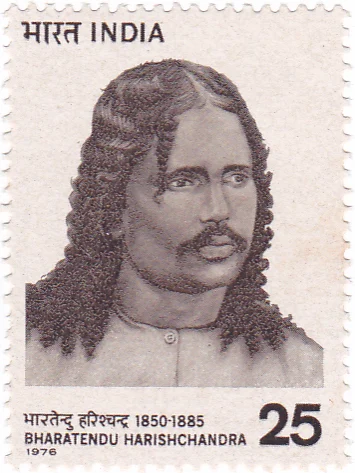
Bharatendu Harishchandra (1850–1885) was an Indian poet, writer, and playwright. His works addressed poverty, British rule, social change, and religious orthodoxy.
Bharatendu HarishchandraSource portrait · India Post, Government of IndiaWikimedia Commons · GODL-IndiaResized and converted; display may crop to fit.
The person behind the words
Life & biography
Bharatendu Harishchandra (9 September 1850 – 6 January 1885) was an Indian poet, writer, and playwright. He wrote dramas, biographical sketches, and travel accounts with the stated aim of influencing public opinion.
Writing under the pen name “Rasa,” he explored the struggles of Indian people and addressed poverty, dependency, British rule, middle-class unrest, and the need for social progress. The supplied biography says he opposed conventional orthodoxy and the manipulations of religious leaders. It also notes that he is often considered a father of modern Hindi literature and theatre; this is a reported characterization, not an independently verified ranking.
From Bharatendu Harishchandra’s November 1884 Ballia speech on how India could progress. This is an excerpt from his own address, not the editor’s introduction. Progress in one’s own language.
From Bharatendu Harishchandra’s November 1884 Ballia speech on how India could progress. This is an excerpt from his own address, not the editor’s introduction. National progress.
From Bharatendu Harishchandra’s November 1884 Ballia speech on how India could progress. This is an excerpt from his own address, not the editor’s introduction. Local craftsmanship.
From Bharatendu Harishchandra’s November 1884 Ballia speech on how India could progress. This is an excerpt from his own address, not the editor’s introduction. Cooperation across communities.
From Bharatendu Harishchandra’s November 1884 Ballia speech on how India could progress. This is an excerpt from his own address, not the editor’s introduction. Habit of effort.
From Bharatendu Harishchandra’s November 1884 Ballia speech on how India could progress. This is an excerpt from his own address, not the editor’s introduction. Education for a livelihood.
From Bharatendu Harishchandra’s November 1884 Ballia speech on how India could progress. This is an excerpt from his own address, not the editor’s introduction. Cooperation in a crisis.
From Bharatendu Harishchandra’s November 1884 Ballia speech on how India could progress. This is an excerpt from his own address, not the editor’s introduction. Opposition to contempt.
From Bharatendu Harishchandra’s November 1884 Ballia speech on how India could progress. This is an excerpt from his own address, not the editor’s introduction. Respect across caste.
From Bharatendu Harishchandra’s November 1884 Ballia speech on how India could progress. This is an excerpt from his own address, not the editor’s introduction. Communal unity.
From Bharatendu Harishchandra’s November 1884 Ballia speech on how India could progress. This is an excerpt from his own address, not the editor’s introduction. Marriage reform.
From Bharatendu Harishchandra’s November 1884 Ballia speech on how India could progress. This is an excerpt from his own address, not the editor’s introduction. Opposition to child marriage.
From Bharatendu Harishchandra’s November 1884 Ballia speech on how India could progress. This is an excerpt from his own address, not the editor’s introduction. Customs and change.
From Bharatendu Harishchandra’s November 1884 Ballia speech on how India could progress. This is an excerpt from his own address, not the editor’s introduction. Finding root causes.
From Bharatendu Harishchandra’s November 1884 Ballia speech on how India could progress. This is an excerpt from his own address, not the editor’s introduction. Progress for everyone.
From Bharatendu Harishchandra’s November 1884 Ballia speech on how India could progress. This is an excerpt from his own address, not the editor’s introduction. All-round progress.
From Bharatendu Harishchandra’s November 1884 Ballia speech on how India could progress. This is an excerpt from his own address, not the editor’s introduction. Take initiative.
From Bharatendu Harishchandra’s November 1884 Ballia speech on how India could progress. This is an excerpt from his own address, not the editor’s introduction. Independent initiative.
From Bharatendu Harishchandra’s November 1884 Ballia speech on how India could progress. This is an excerpt from his own address, not the editor’s introduction. Use of time.
From Bharatendu Harishchandra’s November 1884 Ballia speech on how India could progress. This is an excerpt from his own address, not the editor’s introduction. Progress despite scarcity.