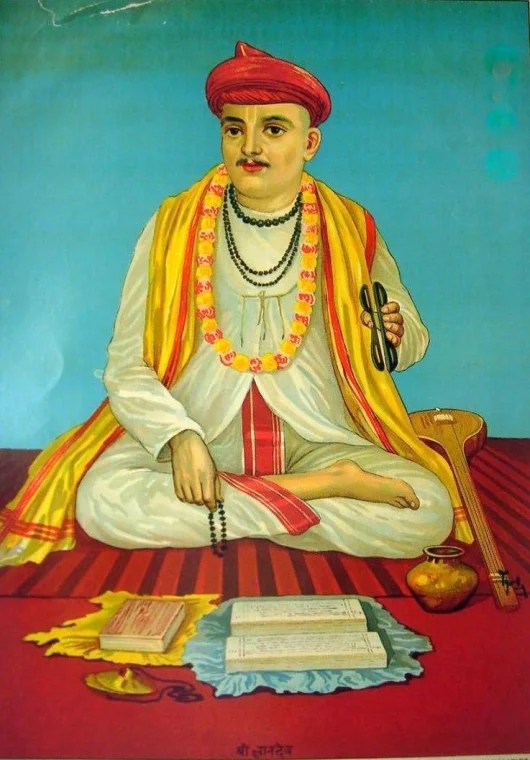
Dnyaneshwar was a 13th-century Marathi saint, poet, philosopher and yogi. He authored Dnyaneshwari, a commentary on the Bhagavad Gita, and Amrutanubhav.
DnyaneshwarSource portrait · Ravi Varma PressWikimedia Commons · Public domainResized and converted; display may crop to fit.
The person behind the words
Life & biography
Dnyaneshwar, also known as Jñāneśvara, Jñānadeva and Dnyandev, was a Marathi saint, poet, philosopher and yogi associated with the Nath and Varkari traditions. The supplied source gives his traditional lifespan as 1275–1296; structured exact dates are not provided.
During his short life, he authored Dnyaneshwari, a commentary on the Bhagavad Gita, and Amrutanubhav. The source describes these as the oldest surviving literary works in Marathi and milestones in Marathi literature. It associates his thought with non-dualistic Advaita Vedanta, yoga and devotion to Vithoba, and says his legacy inspired saint-poets including Eknath and Tukaram. It also reports that he undertook samadhi at Alandi in 1296.
In these Marathi ovis from chapter 12 of the Dnyaneshwari, the commentary develops Krishna’s teaching to Arjuna about the ideal devotee; its first-person voice belongs to that devotional frame.
In these consecutive ovis of the Dnyaneshwari, the Marathi commentary presents an ideal devotee in Krishna’s teaching to Arjuna, not Dnyaneshwar speaking autobiographically.
In these consecutive ovis from the Dnyaneshwari’s commentary on the Gita’s twelfth chapter, Dnyaneshwar describes the ideal devotee through images of impartiality.
In these Marathi verses, the Dnyaneshwari presents Krishna’s teaching to Arjuna about an ideal devotee, using the tree’s shade and sugarcane as images of impartiality.
In these consecutive ovis of the Dnyaneshwari, the devotional teaching to Arjuna describes an ideal devotee through impartiality and the image of a lamp.
In these consecutive ovis of the Dnyaneshwari’s chapter 12, Dnyaneshwar’s Marathi commentary presents qualities of the ideal devotee in Krishna’s teaching to Arjuna.
These consecutive ovis in Dnyaneshwar’s commentary present a quality of the ideal devotee in Krishna’s teaching to Arjuna; the voice is scriptural, not autobiographical.
These consecutive Marathi ovis are Dnyaneshwar’s commentary on Krishna’s teaching to Arjuna about the qualities of a devotee; the divine first-person voice belongs to that teaching’s literary frame.
In these consecutive ovis from chapter 12, Dnyaneshwar’s Marathi commentary renders Krishna’s teaching to Arjuna about a devoted seeker; the first-person “Me” belongs to that scriptural voice.
In Dnyaneshwar’s Marathi commentary on the Gita, this image belongs to a discussion of the qualities of an ideal devotee, not a personal claim by the poet.
In these consecutive Marathi ovis from Dnyaneshwari chapter 12, the devotional commentary portrays qualities of an ideal devotee in its scriptural teaching.
In these consecutive ovis of the Dnyaneshwari, the commentary describes the impartiality of an ideal devotee through images of consciousness and earth.
In Dnyaneshwari, this Marathi verse belongs to the poet’s invocation to the grace of the guru, rather than the later divine speech addressed to Arjuna.