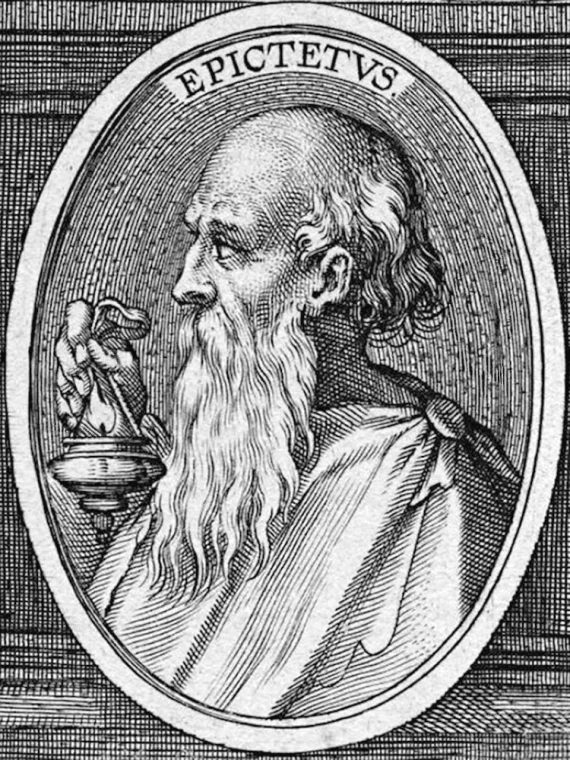
Epictetus was a Greek Stoic philosopher who taught that philosophy was a way of life. His pupil Arrian recorded his teachings in the Discourses and Enchiridion.
EpictetusSource portrait · Theodoor GalleWikimedia Commons · Public domainResized and converted; display may crop to fit.
The person behind the words
Life & biography
Epictetus (c. 50–c. 135 AD) was a Greek Stoic philosopher. Born into slavery at Hierapolis, Phrygia, he studied Stoic philosophy under Musonius Rufus and began teaching after being freed.
After Emperor Domitian banished philosophers from Rome, Epictetus founded a school in Nicopolis. He taught that external events lie beyond our control, while people remain responsible for their own actions. His pupil Arrian recorded his teachings in the Discourses and Enchiridion.
Epictetus’ teaching as arranged by Arrian in the Enchiridion; the later introduction by Albert Salomon is excluded. English wording retained from the cited published translation by Thomas Wentworth Higginson. Hindi is a new editorial translation from that English edition, not directly from the ancient original language.
Epictetus’ teaching as arranged by Arrian in the Enchiridion; the later introduction by Albert Salomon is excluded. English wording retained from the cited published translation by Thomas Wentworth Higginson. Hindi is a new editorial translation from that English edition, not directly from the ancient original language.
Epictetus’ teaching as arranged by Arrian in the Enchiridion; the later introduction by Albert Salomon is excluded. English wording retained from the cited published translation by Thomas Wentworth Higginson. Hindi is a new editorial translation from that English edition, not directly from the ancient original language.
Epictetus’ teaching as arranged by Arrian in the Enchiridion; the later introduction by Albert Salomon is excluded. English wording retained from the cited published translation by Thomas Wentworth Higginson. Hindi is a new editorial translation from that English edition, not directly from the ancient original language.
Epictetus’ teaching as arranged by Arrian in the Enchiridion; the later introduction by Albert Salomon is excluded. English wording retained from the cited published translation by Thomas Wentworth Higginson. Hindi is a new editorial translation from that English edition, not directly from the ancient original language.
Epictetus’ teaching as arranged by Arrian in the Enchiridion; the later introduction by Albert Salomon is excluded. English wording retained from the cited published translation by Thomas Wentworth Higginson. Hindi is a new editorial translation from that English edition, not directly from the ancient original language.
Epictetus’ teaching as arranged by Arrian in the Enchiridion; the later introduction by Albert Salomon is excluded. English wording retained from the cited published translation by Thomas Wentworth Higginson. Hindi is a new editorial translation from that English edition, not directly from the ancient original language.
Epictetus’ teaching as arranged by Arrian in the Enchiridion; the later introduction by Albert Salomon is excluded. English wording retained from the cited published translation by Thomas Wentworth Higginson. Hindi is a new editorial translation from that English edition, not directly from the ancient original language.
Epictetus’ teaching as arranged by Arrian in the Enchiridion; the later introduction by Albert Salomon is excluded. English wording retained from the cited published translation by Thomas Wentworth Higginson. Hindi is a new editorial translation from that English edition, not directly from the ancient original language.
Epictetus’ teaching as arranged by Arrian in the Enchiridion; the later introduction by Albert Salomon is excluded. English wording retained from the cited published translation by Thomas Wentworth Higginson. Hindi is a new editorial translation from that English edition, not directly from the ancient original language.