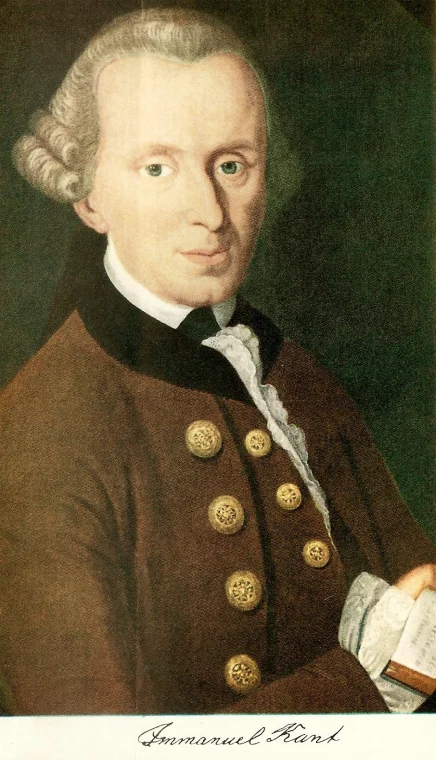
Immanuel Kant (born Emanuel Kant) was a German philosopher, born in Königsberg in 1724. His work ranged across epistemology, metaphysics, ethics, aesthetics, political theory, and philosophy of religion.
Immanuel KantSource portrait · BeckerWikimedia Commons · Public domainResized and converted; display may crop to fit.
The person behind the words
Life & biography
Immanuel Kant, born Emanuel Kant, was born on 22 April 1724 in Königsberg, then in the Kingdom of Prussia. He became a philosopher whose work addressed epistemology, metaphysics, logic, ethics, aesthetics, political theory, and philosophy of religion.
In the Critique of Pure Reason (1781/1787), Kant presented transcendental idealism, arguing that space and time structure experience and that human knowledge concerns appearances rather than things in themselves. He also argued that reason grounds morality and that the categorical imperative binds rational agents. His views on religion are described in the supplied material as disputed.
Kant’s argument in Fundamental Principles of the Metaphysic of Morals; law here concerns moral law, not a blanket command to obey every enacted statute. English wording retained from the cited published translation by Thomas Kingsmill Abbott. Hindi is a new editorial translation from that English edition, not directly from the ancient original language.
Kant’s argument in Fundamental Principles of the Metaphysic of Morals; law here concerns moral law, not a blanket command to obey every enacted statute. English wording retained from the cited published translation by Thomas Kingsmill Abbott. Hindi is a new editorial translation from that English edition, not directly from the ancient original language.
Kant’s argument in Fundamental Principles of the Metaphysic of Morals; law here concerns moral law, not a blanket command to obey every enacted statute. English wording retained from the cited published translation by Thomas Kingsmill Abbott. Hindi is a new editorial translation from that English edition, not directly from the ancient original language.
Kant’s argument in Fundamental Principles of the Metaphysic of Morals; law here concerns moral law, not a blanket command to obey every enacted statute. English wording retained from the cited published translation by Thomas Kingsmill Abbott. Hindi is a new editorial translation from that English edition, not directly from the ancient original language.
Kant’s argument in Fundamental Principles of the Metaphysic of Morals; law here concerns moral law, not a blanket command to obey every enacted statute. English wording retained from the cited published translation by Thomas Kingsmill Abbott. Hindi is a new editorial translation from that English edition, not directly from the ancient original language.
Kant’s argument in Fundamental Principles of the Metaphysic of Morals; law here concerns moral law, not a blanket command to obey every enacted statute. English wording retained from the cited published translation by Thomas Kingsmill Abbott. Hindi is a new editorial translation from that English edition, not directly from the ancient original language.
Kant’s argument in Fundamental Principles of the Metaphysic of Morals; law here concerns moral law, not a blanket command to obey every enacted statute. English wording retained from the cited published translation by Thomas Kingsmill Abbott. Hindi is a new editorial translation from that English edition, not directly from the ancient original language.
Kant’s argument in Fundamental Principles of the Metaphysic of Morals; law here concerns moral law, not a blanket command to obey every enacted statute. English wording retained from the cited published translation by Thomas Kingsmill Abbott. Hindi is a new editorial translation from that English edition, not directly from the ancient original language.
Kant’s argument in Fundamental Principles of the Metaphysic of Morals; law here concerns moral law, not a blanket command to obey every enacted statute. English wording retained from the cited published translation by Thomas Kingsmill Abbott. Hindi is a new editorial translation from that English edition, not directly from the ancient original language.
Kant’s argument in Fundamental Principles of the Metaphysic of Morals; law here concerns moral law, not a blanket command to obey every enacted statute. English wording retained from the cited published translation by Thomas Kingsmill Abbott. Hindi is a new editorial translation from that English edition, not directly from the ancient original language.