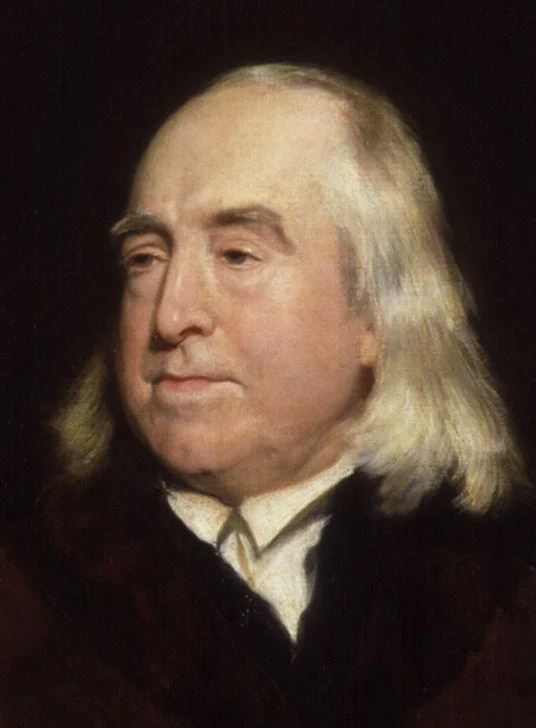
Jeremy Bentham was an English philosopher, jurist, and social reformer, regarded as the founder of modern utilitarianism. His work addressed law, individual freedoms, and social reform.
Jeremy BenthamSource portrait · Henry William PickersgillWikimedia Commons · Public domainResized and converted; display may crop to fit.
The person behind the words
Life & biography
Jeremy Bentham was an English philosopher, jurist, and social reformer whose ideas helped shape modern utilitarianism. His 1789 book, An Introduction to the Principles of Morals and Legislation, presented his theory of utilitarianism.
Bentham advocated individual and economic freedoms, freedom of expression, equal rights for women, and the separation of church and state. He also called for the abolition of slavery and capital punishment. His ideas influenced debates and reforms concerning prisons, schools, poor laws, courts, and Parliament. He died on 6 June 1832.
Bentham’s argument in Chapter I, Of the Principle of Utility; pain and pleasure are the two masters referred to in its opening argument. English wording retained from the cited authored text; Hindi is a new editorial translation.
Bentham’s argument in Chapter I, Of the Principle of Utility; pain and pleasure are the two masters referred to in its opening argument. English wording retained from the cited authored text; Hindi is a new editorial translation.
Bentham’s argument in Chapter I, Of the Principle of Utility; pain and pleasure are the two masters referred to in its opening argument. English wording retained from the cited authored text; Hindi is a new editorial translation.
Bentham’s argument in Chapter I, Of the Principle of Utility; pain and pleasure are the two masters referred to in its opening argument. English wording retained from the cited authored text; Hindi is a new editorial translation.
Bentham’s argument in Chapter I, Of the Principle of Utility; pain and pleasure are the two masters referred to in its opening argument. English wording retained from the cited authored text; Hindi is a new editorial translation.
Bentham’s argument in Chapter I, Of the Principle of Utility; pain and pleasure are the two masters referred to in its opening argument. English wording retained from the cited authored text; Hindi is a new editorial translation.
Bentham’s argument in Chapter I, Of the Principle of Utility; pain and pleasure are the two masters referred to in its opening argument. English wording retained from the cited authored text; Hindi is a new editorial translation.
Bentham’s argument in Chapter I, Of the Principle of Utility; pain and pleasure are the two masters referred to in its opening argument. English wording retained from the cited authored text; Hindi is a new editorial translation.
Bentham’s argument in Chapter I, Of the Principle of Utility; pain and pleasure are the two masters referred to in its opening argument. English wording retained from the cited authored text; Hindi is a new editorial translation.
Bentham’s argument in Chapter I, Of the Principle of Utility; pain and pleasure are the two masters referred to in its opening argument. English wording retained from the cited authored text; Hindi is a new editorial translation.