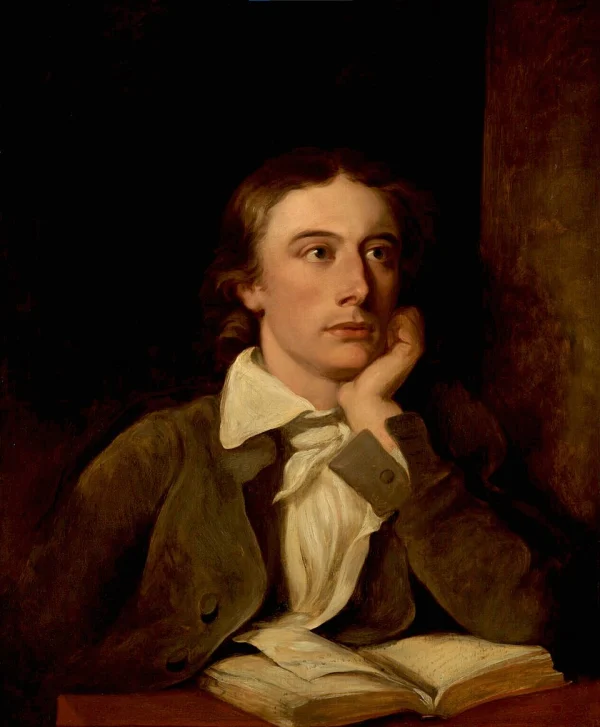
John Keats (1795–1821) was an English poet of the second generation of Romantic poets. His best-known works include “Ode to a Nightingale,” “Ode on a Grecian Urn” and “On First Looking into Chapman’s Homer.”
John KeatsSource portrait · William HiltonWikimedia Commons · Public domainResized and converted; display may crop to fit.
The person behind the words
Life & biography
John Keats was born on 31 October 1795 and died of tuberculosis on 23 February 1821, aged 25. He was an English poet associated with the second generation of Romantic poets, alongside Lord Byron and Percy Bysshe Shelley.
His poems received little attention during his lifetime, but his reputation grew after his death. His work, including “Ode to a Nightingale,” “Ode on a Grecian Urn,” “Sleep and Poetry” and “La Belle Dame sans Merci,” became influential in English literature and on the Pre-Raphaelite movement.
Keats: Poems Published in 1820 — poetic passage in its speaker’s voice; topic: sorrow meeting fleeting beauty. The English text follows this source edition; Hindi is a QuoteKosh editorial translation.
Keats: Poems Published in 1820 — poetic passage in its speaker’s voice; topic: each season has its music. The English text follows this source edition; Hindi is a QuoteKosh editorial translation.
Keats: Poems Published in 1820 — poetic passage in its speaker’s voice; topic: a form beyond easy explanation. The English text follows this source edition; Hindi is a QuoteKosh editorial translation.
Keats: Poems Published in 1820 — poetic passage in its speaker’s voice; topic: an unending spring in art. The English text follows this source edition; Hindi is a QuoteKosh editorial translation.
Keats: Poems Published in 1820 — poetic passage in its speaker’s voice; topic: love held still in art. The English text follows this source edition; Hindi is a QuoteKosh editorial translation.
Keats: Poems Published in 1820 — poetic passage in its speaker’s voice; topic: between vision and waking. The English text follows this source edition; Hindi is a QuoteKosh editorial translation.
Keats: Poems Published in 1820 — poetic passage in its speaker’s voice; topic: the limits of imaginative escape. The English text follows this source edition; Hindi is a QuoteKosh editorial translation.
Keats: Poems Published in 1820 — poetic passage in its speaker’s voice; topic: a song across generations. The English text follows this source edition; Hindi is a QuoteKosh editorial translation.
Keats: Poems Published in 1820 — poetic passage in its speaker’s voice; topic: sensing beauty in darkness. The English text follows this source edition; Hindi is a QuoteKosh editorial translation.
Keats: Poems Published in 1820 — poetic passage in its speaker’s voice; topic: the invisible wings of poetry. The English text follows this source edition; Hindi is a QuoteKosh editorial translation.