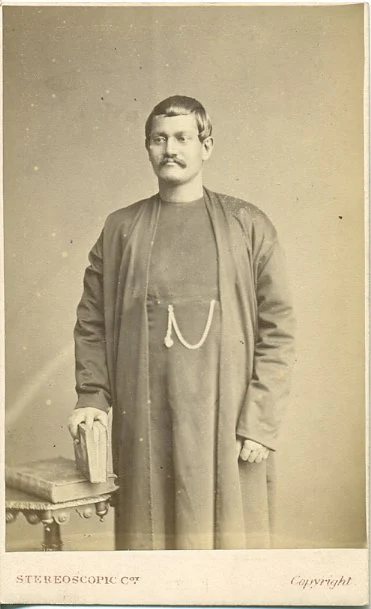
Keshub Chandra Sen was a Bengali religious thinker and social reformer associated with the Brahmo movement. He joined the Brahmo Samaj in 1857 and formed a separate organization in 1866.
Keshub Chandra SenPhotograph · London Stereoscopic CompanyWikimedia Commons · Public domainResized and converted; display may crop to fit.
The person behind the words
Life & biography
Keshub Chandra Sen was a Bengali religious thinker and social reformer associated with the Brahmo movement. He joined the Brahmo Samaj in 1857 and formed a separate organization in 1866.
His theological and ethical essays explore faith, conscience and moral conduct. His public career also involved disagreement over the relationship between religious ideals and social practice.
His writings should be presented as his historical religious perspective. Passages citing earlier scripture or another speaker must keep their original attribution.
Keshub Chandra Sen writes in Keshub Chunder Sen's Essays: Theological and Ethical. This passage belongs to the work's historical discussion; it should be read in that context rather than as a description of present-day society.
Keshub Chandra Sen writes in Keshub Chunder Sen's Essays: Theological and Ethical. This passage belongs to the work's historical discussion; it should be read in that context rather than as a description of present-day society.
Keshub Chandra Sen writes in Keshub Chunder Sen's Essays: Theological and Ethical. This passage belongs to the work's historical discussion; it should be read in that context rather than as a description of present-day society.
Keshub Chandra Sen writes in Keshub Chunder Sen's Essays: Theological and Ethical. This passage belongs to the work's historical discussion; it should be read in that context rather than as a description of present-day society.
Keshub Chandra Sen writes in Keshub Chunder Sen's Essays: Theological and Ethical. This passage belongs to the work's historical discussion; it should be read in that context rather than as a description of present-day society.
Keshub Chandra Sen writes in Keshub Chunder Sen's Essays: Theological and Ethical. This passage belongs to the work's historical discussion; it should be read in that context rather than as a description of present-day society.
Keshub Chandra Sen writes in Keshub Chunder Sen's Essays: Theological and Ethical. This passage belongs to the work's historical discussion; it should be read in that context rather than as a description of present-day society.
Keshub Chandra Sen writes in Keshub Chunder Sen's Essays: Theological and Ethical. This passage belongs to the work's historical discussion; it should be read in that context rather than as a description of present-day society.
Keshub Chandra Sen writes in Keshub Chunder Sen's Essays: Theological and Ethical. This passage belongs to the work's historical discussion; it should be read in that context rather than as a description of present-day society.
Keshub Chandra Sen writes in Keshub Chunder Sen's Essays: Theological and Ethical. This passage belongs to the work's historical discussion; it should be read in that context rather than as a description of present-day society.
Keshub Chandra Sen writes in Keshub Chunder Sen's Essays: Theological and Ethical. This passage belongs to the work's historical discussion; it should be read in that context rather than as a description of present-day society.
Keshub Chandra Sen writes in Keshub Chunder Sen's Essays: Theological and Ethical. This passage belongs to the work's historical discussion; it should be read in that context rather than as a description of present-day society.
Keshub Chandra Sen writes in Keshub Chunder Sen's Essays: Theological and Ethical. This passage belongs to the work's historical discussion; it should be read in that context rather than as a description of present-day society.
Keshub Chandra Sen writes in Keshub Chunder Sen's Essays: Theological and Ethical. This passage belongs to the work's historical discussion; it should be read in that context rather than as a description of present-day society.
Keshub Chandra Sen writes in Keshub Chunder Sen's Essays: Theological and Ethical. This passage belongs to the work's historical discussion; it should be read in that context rather than as a description of present-day society.
Keshub Chandra Sen writes in Keshub Chunder Sen's Essays: Theological and Ethical. This passage belongs to the work's historical discussion; it should be read in that context rather than as a description of present-day society.
Keshub Chandra Sen writes in Keshub Chunder Sen's Essays: Theological and Ethical. This passage belongs to the work's historical discussion; it should be read in that context rather than as a description of present-day society.