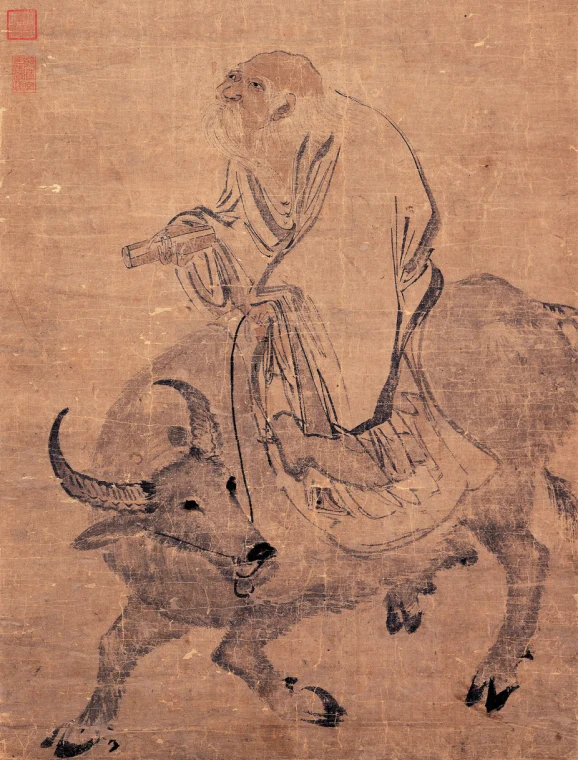
Laozi is the traditional name of an ancient Chinese philosopher associated with the Tao Te Ching and regarded as a founder of Taoism. His identity and dates remain disputed among modern scholars.
LaoziSource portrait · Zhang LuWikimedia Commons · Public domainResized and converted; display may crop to fit.
The person behind the words
Life & biography
Laozi is the name traditionally given to an ancient Chinese philosopher, also identified in accounts as Li Er or Lao Dan. He is regarded as the author or originating teacher associated with the Tao Te Ching, a foundational text of Taoism.
Traditional accounts place him in the state of Chu during the Spring and Autumn period and describe him as a keeper of archival records at the Zhou court and an elder contemporary of Confucius. Modern scholars remain divided over whether Laozi was historical, his dates, and his precise relationship to the received text. The Tao Te Ching influenced Chinese philosophy, religion, literature, and political thought.
The Tao Teh King, traditionally attributed to Laozi; this is the cited English rendering, not a claim of an autograph or recorded speech. English wording retained from the cited published translation by James Legge. Hindi is a new editorial translation from that English edition, not directly from the ancient original language.
The Tao Teh King, traditionally attributed to Laozi; this is the cited English rendering, not a claim of an autograph or recorded speech. English wording retained from the cited published translation by James Legge. Hindi is a new editorial translation from that English edition, not directly from the ancient original language.
The Tao Teh King, traditionally attributed to Laozi; this is the cited English rendering, not a claim of an autograph or recorded speech. English wording retained from the cited published translation by James Legge. Hindi is a new editorial translation from that English edition, not directly from the ancient original language.
The Tao Teh King, traditionally attributed to Laozi; this is the cited English rendering, not a claim of an autograph or recorded speech. English wording retained from the cited published translation by James Legge. Hindi is a new editorial translation from that English edition, not directly from the ancient original language.
The Tao Teh King, traditionally attributed to Laozi; this is the cited English rendering, not a claim of an autograph or recorded speech. English wording retained from the cited published translation by James Legge. Hindi is a new editorial translation from that English edition, not directly from the ancient original language.
The Tao Teh King, traditionally attributed to Laozi; this is the cited English rendering, not a claim of an autograph or recorded speech. English wording retained from the cited published translation by James Legge. Hindi is a new editorial translation from that English edition, not directly from the ancient original language.
The Tao Teh King, traditionally attributed to Laozi; this is the cited English rendering, not a claim of an autograph or recorded speech. English wording retained from the cited published translation by James Legge. Hindi is a new editorial translation from that English edition, not directly from the ancient original language.
The Tao Teh King, traditionally attributed to Laozi; this is the cited English rendering, not a claim of an autograph or recorded speech. English wording retained from the cited published translation by James Legge. Hindi is a new editorial translation from that English edition, not directly from the ancient original language.
The Tao Teh King, traditionally attributed to Laozi; this is the cited English rendering, not a claim of an autograph or recorded speech. English wording retained from the cited published translation by James Legge. Hindi is a new editorial translation from that English edition, not directly from the ancient original language.
The Tao Teh King, traditionally attributed to Laozi; this is the cited English rendering, not a claim of an autograph or recorded speech. English wording retained from the cited published translation by James Legge. Hindi is a new editorial translation from that English edition, not directly from the ancient original language.