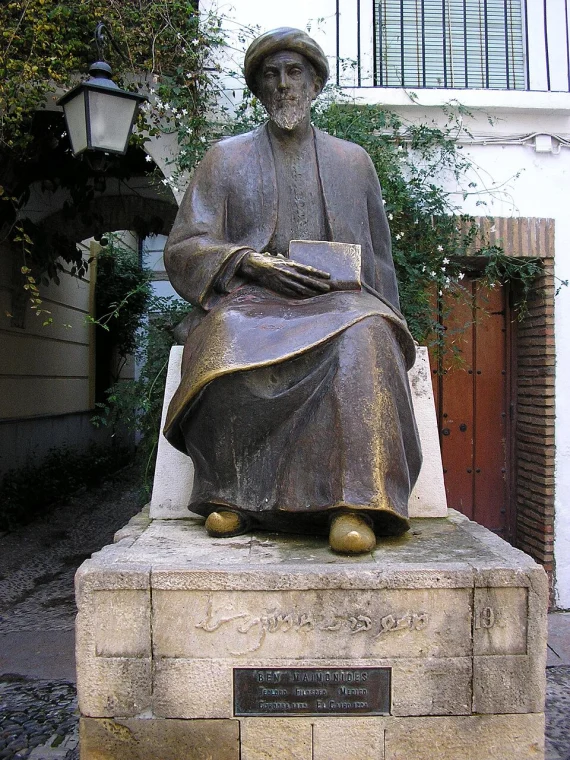
Maimonides, also known as Moses ben Maimon and Rambam, was a Sephardic Jewish rabbi, philosopher, astronomer, and physician. His writings on Jewish law and ethics, including the Mishneh Torah, became central to Jewish scholarship.
MaimonidesSource portrait · No machine-readable author provided. Makinal~commonswiki assumed (based on copyright claims).Wikimedia Commons · CC BY-SA 3.0Resized and converted; display may crop to fit.
The person behind the words
Life & biography
Maimonides (Moses ben Maimon), also called Rambam, was a Sephardic Jewish rabbi whose work addressed Jewish law and ethics. Born in Córdoba on Passover Eve in either 1135 or 1138, he and his family were exiled from Muslim-ruled Spain in 1148 after they refused to convert to Islam. He later lived in several cities, including Fez, Acre, Jerusalem, Alexandria, and Cairo, before settling in Fustat between 1168 and 1171.
Maimonides was also a philosopher, astronomer, and physician, and served as personal physician to Saladin. His fourteen-volume Mishneh Torah became a major codification of Jewish law, and his thirteen principles of faith remain influential in Jewish scholarship. He died on 12 December 1204; the source says he is said to have been buried in Tiberias.
In Part III, Chapter 25 of The Guide for the Perplexed, Maimonides discusses the view that natural things serve purposes, whether or not people recognize them.
In Part III, Chapter 12 of The Guide for the Perplexed, Maimonides uses the availability and cost of necessities to discuss the pursuit of superfluous things.
In Part III, Chapter 10, Maimonides considers how corporeal existence, despite being a source of death and evils, contributes to the continuity and order of the universe.
In Part III, Chapter 8 of The Guide for the Perplexed, Maimonides distinguishes the changing substance of transient bodies from the enduring essence of form.