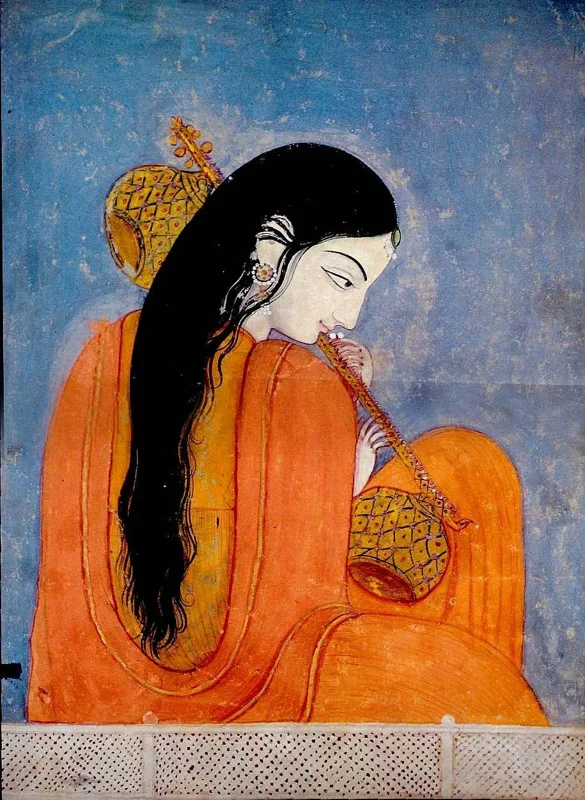
Mirabai was a 16th-century Hindu mystic poet and devotee of Krishna, remembered as a Bhakti saint. Her life is also described in legends whose details vary.
MirabaiHistorical painting · Unknown authorUnknown authorWikimedia Commons · Public domainResized and converted; display may crop to fit.
The person behind the words
Life & biography
Mirabai, also known as Meera and venerated as Sant Meerabai, was a 16th-century Hindu mystic poet and devotee of Krishna. She is remembered as a Bhakti saint, particularly in North Indian Hindu tradition. Her poems express madhurya bhava toward Krishna, and she is mentioned in Bhaktamal as a figure known within the Bhakti movement by about 1600.
Accounts of her life include stories of devotion, music, and conflict with her in-laws, but these traditions are inconsistent and often hagiographic. The source notes that many hymns are attributed to her, while scholars consider only a few hundred likely to be authentic; most surviving written records of the poems date from the 18th century, and some works attributed to her may have been composed later by admirers.
A contiguous poetry excerpt attributed to Mirabai in Ramnaresh Tripathi’s Kavita-Kaumudi I, second edition (1918), printed page 125. The original is historical Hindi with Rajasthani/Braj forms. This is a selected excerpt, not an entire poem; Tripathi is the anthologist, not the quoted poet.
A contiguous poetry excerpt attributed to Mirabai in Ramnaresh Tripathi’s Kavita-Kaumudi I, second edition (1918), printed page 125. The original is historical Hindi with Rajasthani/Braj forms. This is a selected excerpt, not an entire poem; Tripathi is the anthologist, not the quoted poet.
A contiguous poetry excerpt attributed to Mirabai in Ramnaresh Tripathi’s Kavita-Kaumudi I, second edition (1918), printed page 125. The original is historical Hindi with Rajasthani/Braj forms. This is a selected excerpt, not an entire poem; Tripathi is the anthologist, not the quoted poet.
A contiguous poetry excerpt attributed to Mirabai in Ramnaresh Tripathi’s Kavita-Kaumudi I, second edition (1918), printed page 125. The original is historical Hindi with Rajasthani/Braj forms. This is a selected excerpt, not an entire poem; Tripathi is the anthologist, not the quoted poet.
A contiguous poetry excerpt attributed to Mirabai in Ramnaresh Tripathi’s Kavita-Kaumudi I, second edition (1918), printed page 125. The original is historical Hindi with Rajasthani/Braj forms. This is a selected excerpt, not an entire poem; Tripathi is the anthologist, not the quoted poet.
A contiguous poetry excerpt attributed to Mirabai in Ramnaresh Tripathi’s Kavita-Kaumudi I, second edition (1918), printed page 125. The original is historical Hindi with Rajasthani/Braj forms. This is a selected excerpt, not an entire poem; Tripathi is the anthologist, not the quoted poet.
A contiguous poetry excerpt attributed to Mirabai in Ramnaresh Tripathi’s Kavita-Kaumudi I, second edition (1918), printed page 125. The original is historical Hindi with Rajasthani/Braj forms. This is a selected excerpt, not an entire poem; Tripathi is the anthologist, not the quoted poet.
A contiguous poetry excerpt attributed to Mirabai in Ramnaresh Tripathi’s Kavita-Kaumudi I, second edition (1918), printed page 125. The original is historical Hindi with Rajasthani/Braj forms. This is a selected excerpt, not an entire poem; Tripathi is the anthologist, not the quoted poet.
A contiguous poetry excerpt attributed to Mirabai in Ramnaresh Tripathi’s Kavita-Kaumudi I, second edition (1918), printed page 124. The original is historical Hindi with Rajasthani/Braj forms. This is a selected excerpt, not an entire poem; Tripathi is the anthologist, not the quoted poet.
A contiguous poetry excerpt attributed to Mirabai in Ramnaresh Tripathi’s Kavita-Kaumudi I, second edition (1918), printed page 124. The original is historical Hindi with Rajasthani/Braj forms. This is a selected excerpt, not an entire poem; Tripathi is the anthologist, not the quoted poet.
A contiguous poetry excerpt attributed to Mirabai in Ramnaresh Tripathi’s Kavita-Kaumudi I, second edition (1918), printed page 124. The original is historical Hindi with Rajasthani/Braj forms. This is a selected excerpt, not an entire poem; Tripathi is the anthologist, not the quoted poet.
A contiguous poetry excerpt attributed to Mirabai in Ramnaresh Tripathi’s Kavita-Kaumudi I, second edition (1918), printed page 124. The original is historical Hindi with Rajasthani/Braj forms. This is a selected excerpt, not an entire poem; Tripathi is the anthologist, not the quoted poet.
A contiguous poetry excerpt attributed to Mirabai in Ramnaresh Tripathi’s Kavita-Kaumudi I, second edition (1918), printed page 124. The original is historical Hindi with Rajasthani/Braj forms. This is a selected excerpt, not an entire poem; Tripathi is the anthologist, not the quoted poet.
A contiguous poetry excerpt attributed to Mirabai in Ramnaresh Tripathi’s Kavita-Kaumudi I, second edition (1918), printed page 124. The original is historical Hindi with Rajasthani/Braj forms. This is a selected excerpt, not an entire poem; Tripathi is the anthologist, not the quoted poet.
A contiguous poetry excerpt attributed to Mirabai in Ramnaresh Tripathi’s Kavita-Kaumudi I, second edition (1918), printed page 124. The original is historical Hindi with Rajasthani/Braj forms. This is a selected excerpt, not an entire poem; Tripathi is the anthologist, not the quoted poet.
A contiguous poetry excerpt attributed to Mirabai in Ramnaresh Tripathi’s Kavita-Kaumudi I, second edition (1918), printed page 124. The original is historical Hindi with Rajasthani/Braj forms. This is a selected excerpt, not an entire poem; Tripathi is the anthologist, not the quoted poet.
A contiguous poetry excerpt attributed to Mirabai in Ramnaresh Tripathi’s Kavita-Kaumudi I, second edition (1918), printed page 124. The original is historical Hindi with Rajasthani/Braj forms. This is a selected excerpt, not an entire poem; Tripathi is the anthologist, not the quoted poet.
A contiguous poetry excerpt attributed to Mirabai in Ramnaresh Tripathi’s Kavita-Kaumudi I, second edition (1918), printed page 124. The original is historical Hindi with Rajasthani/Braj forms. This is a selected excerpt, not an entire poem; Tripathi is the anthologist, not the quoted poet.
A contiguous poetry excerpt attributed to Mirabai in Ramnaresh Tripathi’s Kavita-Kaumudi I, second edition (1918), printed page 124. The original is historical Hindi with Rajasthani/Braj forms. This is a selected excerpt, not an entire poem; Tripathi is the anthologist, not the quoted poet.
A contiguous poetry excerpt attributed to Mirabai in Ramnaresh Tripathi’s Kavita-Kaumudi I, second edition (1918), printed page 123. The original is historical Hindi with Rajasthani/Braj forms. This is a selected excerpt, not an entire poem; Tripathi is the anthologist, not the quoted poet.