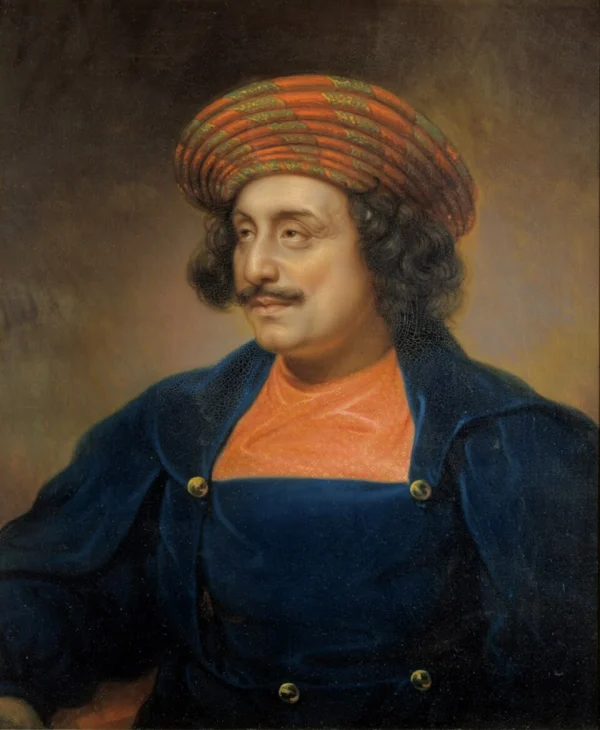
Raja Ram Mohan Roy was an Indian reformer and writer associated with the formation of the Brahmo Sabha in 1828. His work addressed religious interpretation, education and social practices.
Raja Ram Mohan RoySource portrait · Rembrandt PealeWikimedia Commons · Public domainResized and converted; display may crop to fit.
The person behind the words
Life & biography
Raja Ram Mohan Roy was an Indian reformer and writer associated with the formation of the Brahmo Sabha in 1828. His work addressed religious interpretation, education and social practices.
His English works contain public appeals, arguments and correspondence alongside translations and compilations. Only his own prose should be attributed to him as an original quotation; passages he translated from scripture retain their earlier authorship.
His intellectual legacy is connected with debates on social reform and modern education in nineteenth-century India.
From Raja Ram Mohan Roy's own prose in The English works of Raja Rammohun Roy. Edited by Jogendra Chunder Ghose. The statement belongs to this historical work and is not a claim about present-day conditions.
From Raja Ram Mohan Roy's own prose in The English works of Raja Rammohun Roy. Edited by Jogendra Chunder Ghose. The statement belongs to this historical work and is not a claim about present-day conditions.
From Raja Ram Mohan Roy's own prose in The English works of Raja Rammohun Roy. Edited by Jogendra Chunder Ghose. The statement belongs to this historical work and is not a claim about present-day conditions.
From Raja Ram Mohan Roy's own prose in The English works of Raja Rammohun Roy. Edited by Jogendra Chunder Ghose. The statement belongs to this historical work and is not a claim about present-day conditions.
From Raja Ram Mohan Roy's own prose in The English works of Raja Rammohun Roy. Edited by Jogendra Chunder Ghose. The statement belongs to this historical work and is not a claim about present-day conditions.
As part of his answer about impediments to justice, Roy points to the absence of court reports and a public press to scrutinize proceedings in interior courts.
Roy describes the consequences of distant courts and cases that remain undecided for years: wrongdoers gain confidence while innocent and oppressed people lose hope.
Asked to identify practical defects in the judicial system, Roy lists shortages of judges and magistrates, insufficient language qualifications, and the absence of a proper legal code.
This answer responds to a question about India’s judicial system. Roy makes the system’s suitability conditional on having enough qualified judges and a proper code of laws.