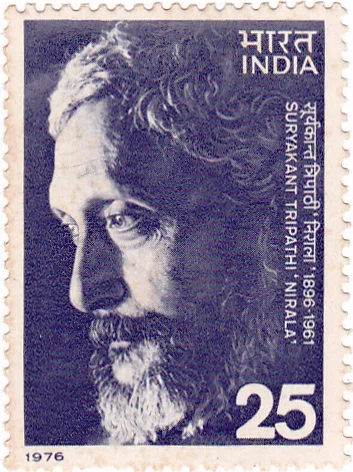
Suryakant Tripathi Nirala was a Hindi poet, writer, composer and sketch artist. He is associated with the Chhayavad period and is noted in the supplied source for pioneering free verse in Hindi poetry.
Suryakant Tripathi NiralaSource portrait · India Post, Government of IndiaWikimedia Commons · GODL-IndiaResized and converted; display may crop to fit.
The person behind the words
Life & biography
Suryakant Tripathi Nirala (21 February 1899–15 October 1961) wrote in Hindi and worked as a poet, writer, composer and sketch artist. The supplied biographical source identifies him with the Chhayavad period and notes his mastery of traditional poetic meters.
The source also credits him with pioneering free verse in Hindi poetry, showing that poetry could retain rhythm and poetic quality without rhyming lines. It describes his writing as attentive to nature and social injustice, and places his work across traditional and contemporary themes. The supplied structured date gives his death as 15 October 1961; no birth date is entered because the editorial instructions restrict dates to the structured exact date fields.
A contiguous selected excerpt from Nirala’s poem in Anima (1943), read in the scan-backed Hindi Wikisource edition. The quoted voice is literary; no autobiographical event is inferred. This is an excerpt, not the entire poem.
A contiguous selected excerpt from Nirala’s poem in Anima (1943), read in the scan-backed Hindi Wikisource edition. The quoted voice is literary; no autobiographical event is inferred. This is an excerpt, not the entire poem.
A contiguous selected excerpt from Nirala’s poem in Anima (1943), read in the scan-backed Hindi Wikisource edition. The quoted voice is literary; no autobiographical event is inferred. This is an excerpt, not the entire poem.
A contiguous selected excerpt from Nirala’s poem in Anima (1943), read in the scan-backed Hindi Wikisource edition. The quoted voice is literary; no autobiographical event is inferred. This is an excerpt, not the entire poem.
A contiguous selected excerpt from Nirala’s poem in Anima (1943), read in the scan-backed Hindi Wikisource edition. The quoted voice is literary; no autobiographical event is inferred. This is an excerpt, not the entire poem.
A contiguous selected excerpt from Nirala’s poem in Anima (1943), read in the scan-backed Hindi Wikisource edition. The quoted voice is literary; no autobiographical event is inferred. This is an excerpt, not the entire poem.
A contiguous selected excerpt from Nirala’s poem in Anima (1943), read in the scan-backed Hindi Wikisource edition. The quoted voice is literary; no autobiographical event is inferred. This is an excerpt, not the entire poem.
A contiguous selected excerpt from Nirala’s poem in Anima (1943), read in the scan-backed Hindi Wikisource edition. The quoted voice is literary; no autobiographical event is inferred. This is an excerpt, not the entire poem.
A contiguous selected excerpt from Nirala’s poem in Anima (1943), read in the scan-backed Hindi Wikisource edition. The quoted voice is literary; no autobiographical event is inferred. This is an excerpt, not the entire poem.
A contiguous selected excerpt from Nirala’s poem in Anima (1943), read in the scan-backed Hindi Wikisource edition. The quoted voice is literary; no autobiographical event is inferred. This is an excerpt, not the entire poem.
A contiguous selected excerpt from Nirala’s poem in Anima (1943), read in the scan-backed Hindi Wikisource edition. The quoted voice is literary; no autobiographical event is inferred. This is an excerpt, not the entire poem.
A contiguous selected excerpt from Nirala’s poem in Anima (1943), read in the scan-backed Hindi Wikisource edition. The quoted voice is literary; no autobiographical event is inferred. This is an excerpt, not the entire poem.
A contiguous selected excerpt from Nirala’s poem in Anima (1943), read in the scan-backed Hindi Wikisource edition. The quoted voice is literary; no autobiographical event is inferred. This is an excerpt, not the entire poem.
A contiguous selected excerpt from Nirala’s poem in Anima (1943), read in the scan-backed Hindi Wikisource edition. The quoted voice is literary; no autobiographical event is inferred. This is an excerpt, not the entire poem.
A contiguous selected excerpt from Nirala’s poem in Anima (1943), read in the scan-backed Hindi Wikisource edition. The quoted voice is literary; no autobiographical event is inferred. This is an excerpt, not the entire poem.
A contiguous selected excerpt from Nirala’s poem in Anima (1943), read in the scan-backed Hindi Wikisource edition. The quoted voice is literary; no autobiographical event is inferred. This is an excerpt, not the entire poem.
A contiguous selected excerpt from Nirala’s poem in Anima (1943), read in the scan-backed Hindi Wikisource edition. The quoted voice is literary; no autobiographical event is inferred. This is an excerpt, not the entire poem.
A contiguous selected excerpt from Nirala’s poem in Anima (1943), read in the scan-backed Hindi Wikisource edition. The quoted voice is literary; no autobiographical event is inferred. This is an excerpt, not the entire poem.
A contiguous selected excerpt from Nirala’s poem in Anima (1943), read in the scan-backed Hindi Wikisource edition. The quoted voice is literary; no autobiographical event is inferred. This is an excerpt, not the entire poem.
A contiguous selected excerpt from Nirala’s poem in Anima (1943), read in the scan-backed Hindi Wikisource edition. The quoted voice is literary; no autobiographical event is inferred. This is an excerpt, not the entire poem.