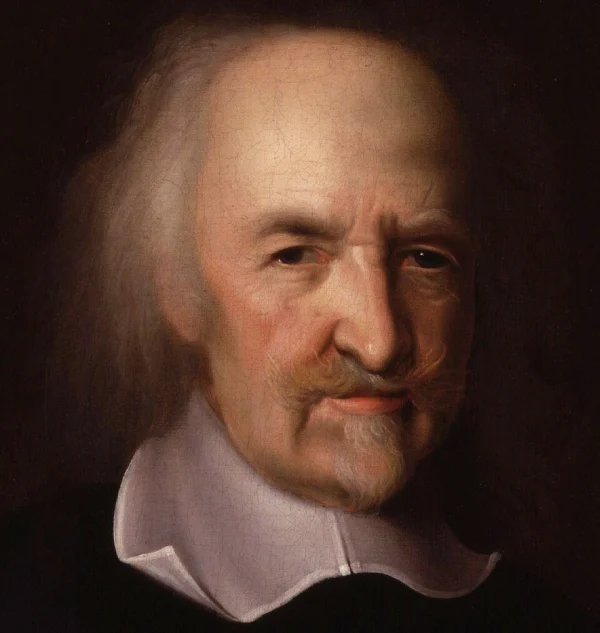
Thomas Hobbes was an English philosopher and political theorist, best known for Leviathan (1651) and his influential account of social contract theory. He is considered one of the founders of modern political philosophy.
Thomas HobbesSource portrait · John Michael WrightWikimedia Commons · Public domainResized and converted; display may crop to fit.
The person behind the words
Life & biography
Thomas Hobbes (5 April 1588–4 December 1679) was an English philosopher and political theorist. He studied at Oxford and graduated from the University of Cambridge in 1608. He later tutored the Cavendish family and travelled extensively in Europe, where he met intellectual figures including Galileo.
Hobbes’s best-known work, Leviathan (1651), presents an influential formulation of social contract theory and argues for governance by an absolute sovereign as a response to conflict. His other major works include De Cive (1642), De Corpore (1655), De Homine (1658), and the posthumously published Behemoth (1681). His work also addressed history, jurisprudence, geometry, optics, theology, and ethics.
Leviathan — authorial reflection or argument; topic: human capacities and civic duties. The English text follows this source edition; Hindi is a QuoteKosh editorial translation.
Leviathan — authorial reflection or argument; topic: consequences beyond foresight. The English text follows this source edition; Hindi is a QuoteKosh editorial translation.
Leviathan — authorial reflection or argument; topic: expertise shown through practice. The English text follows this source edition; Hindi is a QuoteKosh editorial translation.
Leviathan — authorial reflection or argument; topic: against punishing the innocent. The English text follows this source edition; Hindi is a QuoteKosh editorial translation.
Leviathan — authorial reflection or argument; topic: an error is not a binding rule. The English text follows this source edition; Hindi is a QuoteKosh editorial translation.
Leviathan — authorial reflection or argument; topic: acknowledging natural equality. The English text follows this source edition; Hindi is a QuoteKosh editorial translation.
Leviathan — authorial reflection or argument; topic: a character unwilling to deceive. The English text follows this source edition; Hindi is a QuoteKosh editorial translation.
Leviathan — authorial reflection or argument; topic: justice and keeping agreements. The English text follows this source edition; Hindi is a QuoteKosh editorial translation.
Leviathan — authorial reflection or argument; topic: happiness as continuing desire. The English text follows this source edition; Hindi is a QuoteKosh editorial translation.
Leviathan — authorial reflection or argument; topic: greatness beyond mockery. The English text follows this source edition; Hindi is a QuoteKosh editorial translation.
In Leviathan, Hobbes describes how a person calls fear of invisible powers religion in himself, but superstition in people whose worship differs from his own.