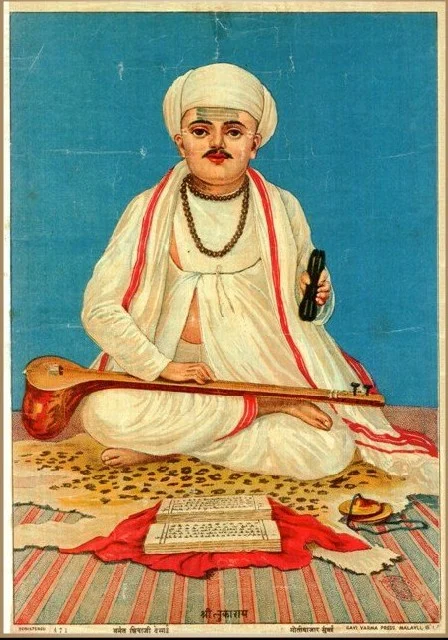
Tukaram was a 17th-century Hindu Marathi saint of the Varkari Sampradaya and a devotee of Vithoba. He is known for devotional abhanga poetry, including poems addressing social reform.
TukaramSource portrait · Anant Shivaji Desai, Ravi Varma PressWikimedia Commons · Public domainResized and converted; display may crop to fit.
The person behind the words
Life & biography
Tukaram, also known as Tuka, Tukobaraya, and Tukoba, was a Hindu Marathi saint of the Varkari Sampradaya who lived in the 17th century. He was a devotee of Vithoba, a form of Vishnu.
He is best known for devotional poetry called abhanga, which is popular in Maharashtra. Many of his poems deal with social reform. Exact birth and death dates are not supplied in the source.
In this abhanga, Tukaram adopts the literary voice of a devotee/bride absorbed in Hari. Household relations, scandal and union belong to that devotional metaphor, not an autobiographical admission.
In this abhanga, Tukaram adopts the literary voice of a devotee/bride absorbed in Hari. Household relations, scandal and union belong to that devotional metaphor, not an autobiographical admission.
In this abhanga, Tukaram adopts the literary voice of a devotee/bride absorbed in Hari. Household relations, scandal and union belong to that devotional metaphor, not an autobiographical admission.
In this abhanga, Tukaram adopts the literary voice of a devotee/bride absorbed in Hari. Household relations, scandal and union belong to that devotional metaphor, not an autobiographical admission.
In this abhanga, Tukaram adopts the literary voice of a devotee/bride absorbed in Hari. Household relations, scandal and union belong to that devotional metaphor, not an autobiographical admission.
In this abhanga, Tukaram adopts the literary voice of a devotee/bride absorbed in Hari. Household relations, scandal and union belong to that devotional metaphor, not an autobiographical admission.
In this abhanga, Tukaram adopts the literary voice of a devotee/bride absorbed in Hari. Household relations, scandal and union belong to that devotional metaphor, not an autobiographical admission.
In this abhanga, Tukaram adopts the literary voice of a devotee/bride absorbed in Hari. Household relations, scandal and union belong to that devotional metaphor, not an autobiographical admission.
In this abhanga, Tukaram adopts the literary voice of a devotee/bride absorbed in Hari. Household relations, scandal and union belong to that devotional metaphor, not an autobiographical admission.
In this abhanga, Tukaram adopts the literary voice of a devotee/bride absorbed in Hari. Household relations, scandal and union belong to that devotional metaphor, not an autobiographical admission.
In this abhanga, Tukaram adopts the literary voice of a devotee/bride absorbed in Hari. Household relations, scandal and union belong to that devotional metaphor, not an autobiographical admission.
In this abhanga, Tukaram adopts the literary voice of a devotee/bride absorbed in Hari. Household relations, scandal and union belong to that devotional metaphor, not an autobiographical admission.
In this abhanga, Tukaram adopts the literary voice of a devotee/bride absorbed in Hari. Household relations, scandal and union belong to that devotional metaphor, not an autobiographical admission.
In this abhanga, Tukaram adopts the literary voice of a devotee/bride absorbed in Hari. Household relations, scandal and union belong to that devotional metaphor, not an autobiographical admission.
In this abhanga, Tukaram addresses Vithoba in devotional language, asking for the divine presence in his heart and finding happiness at the deity’s feet.