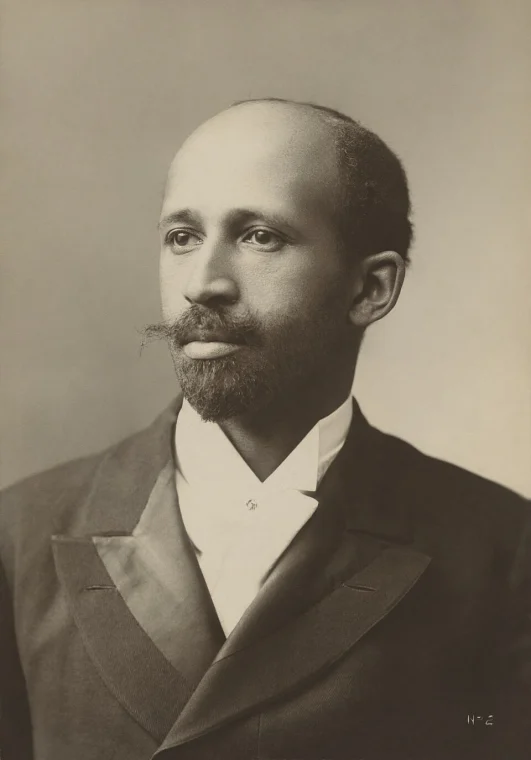
Sociologist, writer, historian, civil rights activist, Pan-Africanist
W. E. B. Du Bois (1868–1963) was an American sociologist, writer, historian, and Pan-Africanist civil rights activist. He helped found the NAACP and wrote influential works including The Souls of Black Folk and Black Reconstruction in America.
W. E. B. Du BoisSource portrait · James E. Purdy / Adam CuerdenWikimedia Commons · CC0Resized and converted; display may crop to fit.
The person behind the words
Life & biography
W. E. B. Du Bois was born in Great Barrington, Massachusetts, on February 23, 1868. He completed graduate work at Harvard University, becoming the first African American to earn a doctorate, and later taught at Atlanta University. He became a leader of the Niagara Movement and helped found the National Association for the Advancement of Colored People (NAACP) in 1909.
A prolific writer and Pan-Africanist, Du Bois challenged racism and discrimination in his books, articles, and work as editor of the NAACP journal The Crisis. His works include The Souls of Black Folk and Black Reconstruction in America. He spent his final years in Ghana and died in Accra on August 27, 1963.
The Souls of Black Folk — authorial reflection or argument; topic: knowing the world and oneself. The English text follows this source edition; Hindi is a QuoteKosh editorial translation.
The Souls of Black Folk — authorial reflection or argument; topic: the church as a community institution. The English text follows this source edition; Hindi is a QuoteKosh editorial translation.
The Souls of Black Folk — authorial reflection or argument; topic: a landscape carrying history. The English text follows this source edition; Hindi is a QuoteKosh editorial translation.
The Souls of Black Folk — authorial reflection or argument; topic: unequal support for higher education. The English text follows this source edition; Hindi is a QuoteKosh editorial translation.
The Souls of Black Folk — authorial reflection or argument; topic: careful thought and education. The English text follows this source edition; Hindi is a QuoteKosh editorial translation.
The Souls of Black Folk — authorial reflection or argument; topic: education as a search for truth. The English text follows this source edition; Hindi is a QuoteKosh editorial translation.
The Souls of Black Folk — authorial reflection or argument; topic: ideals beyond the pursuit of wealth. The English text follows this source edition; Hindi is a QuoteKosh editorial translation.
The Souls of Black Folk — authorial reflection or argument; topic: the reality of a difficult life. The English text follows this source edition; Hindi is a QuoteKosh editorial translation.
The Souls of Black Folk — authorial reflection or argument; topic: the work an institution leaves unfinished. The English text follows this source edition; Hindi is a QuoteKosh editorial translation.
The Souls of Black Folk — authorial reflection or argument; topic: freedom in the whole of life. The English text follows this source edition; Hindi is a QuoteKosh editorial translation.
In chapter XII, Du Bois examines moral efforts against the slave trade and argues that societies often fail to confront wrongs when doing so requires exceptional moral resolve.
In Chapter XI of The Negro, Du Bois argues that racial prejudice persisted even when Black people demonstrated competence and integrity in public life.
In The Negro, Du Bois argues that Black voters demonstrated a capacity to learn and pursue honest, effective government despite the injustices of Reconstruction.
In Chapter V of The Souls of Black Folk, Du Bois argues that education should develop both skilled workers and thinkers, guided by ideals beyond money or fame.
In Chapter V, Du Bois argues that universities should connect practical life with broad knowledge, rather than serve only vocational or social functions.